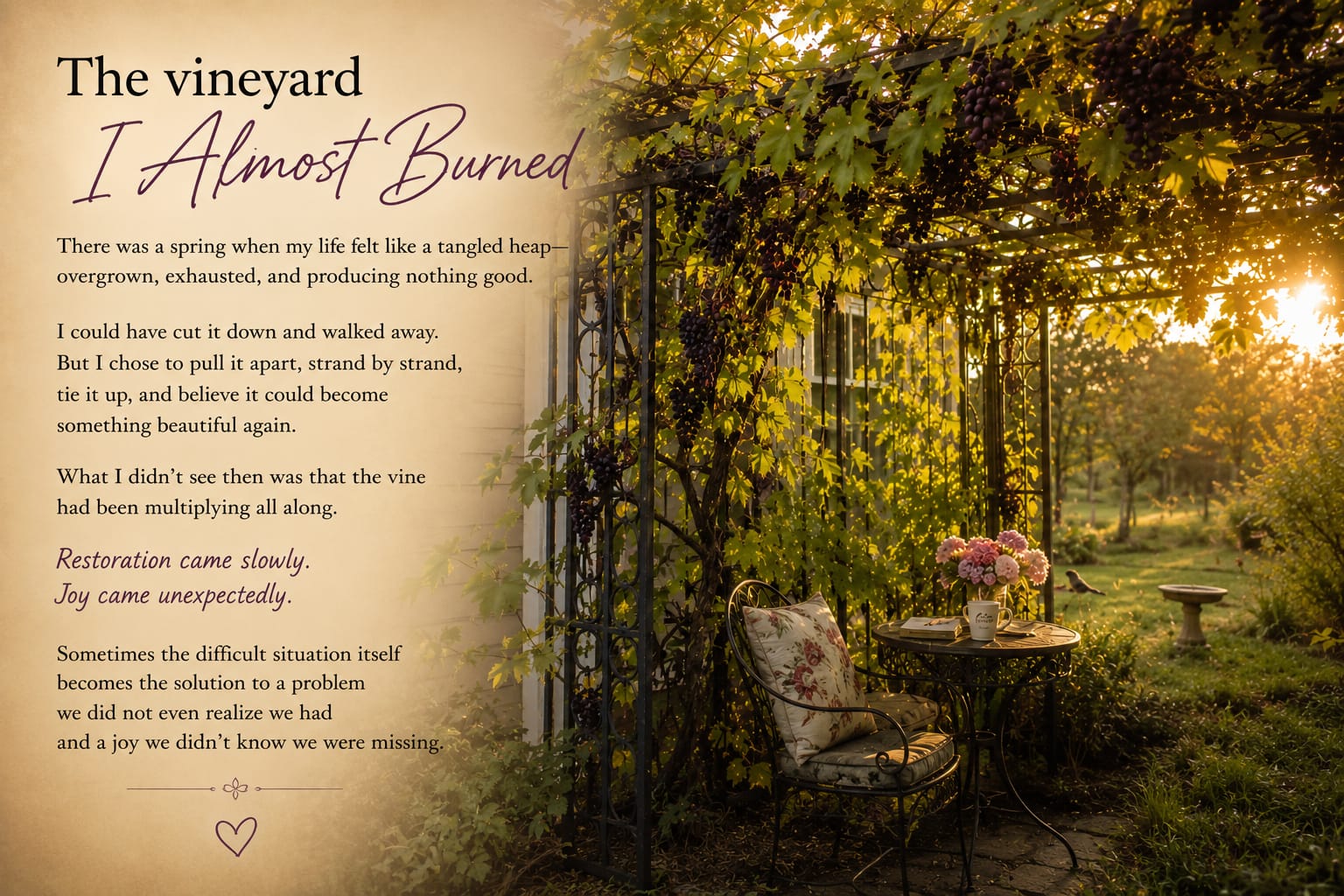
The Vineyard I Almost Burned
“The world breaks everyone and afterward many are strong at the broken places.” — Ernest Hemingway
There was a spring, shortly after my separation during divorce, when everything felt fractured at once.
The separation had happened in winter—abrupt, disorienting, the kind of shift that leaves you standing in a life that no longer fits. By the time spring arrived, I was carrying more than I knew how to hold: four children, a new job, my mother in hospice care, finances I didn’t yet understand, and the quiet grief of realizing the future I had pictured was gone.
I knew my life before hadn’t been healthy or whole. But even broken dreams hurt—especially the ones you finally accept you can’t keep.
Everywhere I looked felt like evidence of failure. Every room. Every responsibility. Every unfinished thing that used to feel manageable now felt heavy.
That spring, I decided to work on the backyard.
Our porch had an old metal canopy frame attached to it. The canopy itself had torn away years earlier, leaving only the bare structure standing like forgotten columns. Beside it sat a massive heap of grapevine—once orderly, once trained carefully along a beam, now collapsed into itself.
The original wooden support had given out long ago. The vine had fallen and spread across the ground in a tangled, overgrown mat. It barely produced fruit anymore—just a few scattered grapes here and there, quickly claimed by birds.
Most people would have cut it down and burned it.
Honestly, that would have been the practical choice.
I stood there looking at it and quietly prayed,
“Lord… my life feels like this grapevine.”
Overgrown.
Exhausted.
Unfruitful.
Hard to imagine restoring.
But something in me couldn’t bring myself to destroy it.
So I started pulling it apart—slowly, strand by strand, like untangling a pile of fine chains. Some sections had to be cut away completely. Others I lifted carefully and tied back onto the old metal frame with garden wire.
It took the entire day.
At first, I cried as I worked. The kind of crying that comes when you’re too tired to hold anything in anymore. Every movement felt like it carried the weight of everything I was trying to survive.
But somewhere in the middle of it, something shifted.
As I untangled the mess, I realized something surprising: it hadn’t stopped growing—it had simply stopped showing it. What looked like one dying vine had quietly multiplied beneath the surface into several separate vines, all hidden inside the chaos.
I kept going.
My hands ached from the clippers. My legs burned from kneeling in the dirt. By the end of the day, I looked like someone who had been completely undone by a backyard project.
But I felt something I hadn’t felt in a long time: hope.
Even my breathing changed.
At first, the sighs were heavy with discouragement—this is too much.
Then they became pauses—what if this could be something again?
And by evening, they were something closer to relief.
When I finally stepped back, the transformation was already visible. The vine was no longer a collapsed heap—it was climbing again. Woven back into structure. Reclaimed.
My neighbor came outside and said how beautiful it looked.
Beautiful.
No one had used that word about it in years.
I didn’t expect it to produce fruit again. I was simply grateful it no longer looked like ruin. It even became practical again—offering shade where I could never afford a proper canopy.
But the real surprise came months later.
The vines exploded with grapes.
Not a few clusters—buckets of them.
They spread across the frame, draped over the porch, and turned the space into living shade. Birds came constantly, not to fight over scraps, but to feast in abundance. It felt like the yard itself had come back to life.
I started sitting out there for long stretches just to watch it all.
Not long after, the world went quiet with COVID. Everything felt uncertain and closed in. But I already had something steady—a shaded porch filled with birdsong and heavy clusters of grapes hanging late into the season.
That old ruined vine became peace.
Looking back, I see now what I couldn’t see then.
Sometimes the very thing that looks like it needs to be destroyed is the thing God is quietly rebuilding. Sometimes what appears collapsed is actually still alive underneath. And sometimes the weight that brought something down is also what created deeper roots.
And in the middle of tending what I thought had no future, I realized something was being restored in me too.
Not everything tangled needs to be burned.
Sometimes what looks ruined is simply waiting for someone willing to untangle it.
Leave a Reply