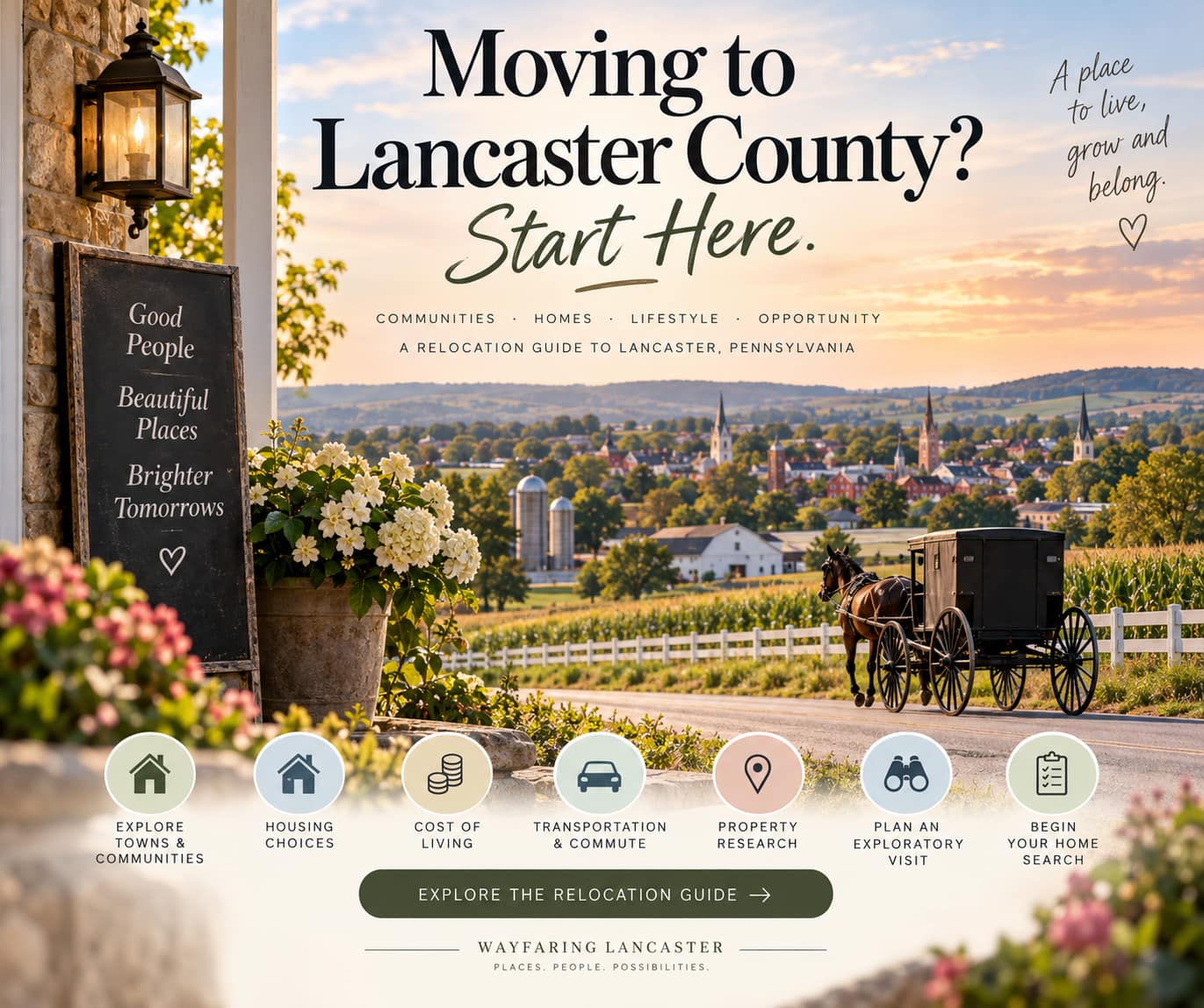
A Relocation Guide to Lancaster, Pennsylvania
Thinking about moving to Lancaster County, Pennsylvania?
You may already know Lancaster for its farmland, Amish communities, historic towns and beautiful countryside. But living here is more layered than the picture many visitors have of Lancaster County.
You can live in a walkable city neighborhood, a small borough, a newer suburban development, a historic home, a 55+ community, or on several acres—and still call Lancaster County home.
That variety is one of the things that makes relocating here interesting. It can also make deciding where to live in Lancaster County surprisingly complicated.
Before you start looking at houses, start with the bigger picture.
Explore the Wayfaring Lancaster Relocation Guide
The guide was created to help you explore communities, compare your options and begin narrowing down what part of Lancaster County might fit the life you actually want to live.
First, Understand That “Lancaster” Can Mean Very Different Things
When someone tells me they want to move to Lancaster, one of my first questions is usually some version of:
What does Lancaster look like in your mind?
Because Lancaster City is only one part of Lancaster County.
You might prefer the restaurants, architecture and walkability of Lancaster City. You may be drawn to the charm of Lititz. Perhaps you want convenient access to shopping and major roads around Manheim Township.
Go farther east and communities such as New Holland, East Earl and Leola offer a different feel. Ephrata and Denver provide another set of options in northern Lancaster County, while Mount Joy and Elizabethtown can make sense for people who regularly travel west toward Harrisburg.
Southern Lancaster County feels different again.
There isn’t one “best place to live in Lancaster County.”
There are communities that fit different priorities.
That distinction matters when you’re relocating.
Compare Lancaster County Towns Before Comparing Houses
Before creating a list of houses, create a list of communities.
Consider what you want everyday life to look like.
Do you want to walk to restaurants and coffee shops? Would you rather see fields outside your window? Do you want a neighborhood with sidewalks? Are you looking for acreage? How important is highway access? How often will you travel to Philadelphia, Harrisburg, Baltimore or another employment center?
Your answer can dramatically change where you should begin exploring.
This is why the Wayfaring Lancaster Relocation Guide starts with lifestyle and location rather than simply showing you real estate listings.
A beautiful house in the wrong location isn’t necessarily the right home.
Explore the Different Housing Choices in Lancaster County
One advantage of buying a home in Lancaster County is the diversity of the housing stock.
Depending on location and budget, you’ll encounter everything from historic city homes and traditional borough properties to suburban developments, condominiums, townhouses, newer construction, farmhouses, rural acreage and active-adult communities.
That means two Lancaster County homes with similar prices may offer completely different lifestyles.
An older property might offer character and a walkable location but require more maintenance.
New construction may offer modern systems and lower immediate maintenance but could include HOA fees, smaller lots or a longer commute.
A rural property may provide the space you’ve dreamed about—but introduce questions about wells, septic systems, zoning, easements, agricultural uses or property maintenance.
Don’t compare square footage alone.
Compare how you will live in the property.
What Does It Cost to Live in Lancaster County?
When researching the cost of living in Lancaster, PA, housing price is only the beginning.
Property taxes can vary by municipality and school district. Homeowners insurance, utilities, HOA or condominium fees, commuting expenses and property maintenance should also be considered.
A rural home may have a well and septic system rather than public utilities. An older home may require a different maintenance budget than new construction. A larger property might mean additional landscaping, equipment or upkeep.
If you’re relocating from another state or metropolitan area, don’t assume that a lower purchase price automatically means every aspect of living here will cost less.
Build a realistic monthly budget around the specific property you’re considering.
Transportation: Where Will You Need to Go?
Lancaster County is largely a driving-oriented area, particularly once you leave Lancaster City and the larger boroughs.
Your commute deserves serious consideration.
Drive the route during the time of day you would actually travel it. A road that looks easy on a map may feel very different during weekday traffic—or behind farm equipment on a rural two-lane road.
Lancaster does have public transportation, including fixed-route and paratransit service through Red Rose Transit/SCTA. Lancaster is also located along Amtrak’s Keystone Corridor. Lancaster Station is served by Keystone Service and Pennsylvanian trains, providing rail connections toward Harrisburg, Philadelphia and New York.
For someone who occasionally needs Philadelphia or New York but doesn’t want to live there, rail access can be an important consideration.
Research the Property, Not Just the House
This is one of the areas I believe deserves more attention during the home-buying process.
A house can look wonderful during a showing while important questions remain about the property itself.
Depending on what you’re buying, research might include:
Property taxes and assessment history, zoning, flood hazards, parcel boundaries, easements, public versus private utilities, wells and septic systems, land use, subdivision considerations, Clean and Green enrollment, agricultural preservation, or potential building restrictions.
Lancaster County’s GIS resources include data layers for parcels, municipal boundaries, zoning, sewer infrastructure and flood hazards, among other property information.
Of course, online research doesn’t replace professional due diligence. Attorneys, inspectors, surveyors, engineers, lenders, appraisers, municipalities and other specialists may need to answer specific questions.
The goal is to know which questions need to be asked before you buy.
Planning an Exploratory Visit to Lancaster County
If you’re moving from outside the area, I strongly recommend visiting Lancaster County as a potential resident rather than only as a tourist.
Don’t spend the entire trip seeing attractions.
Spend some time doing ordinary things.
Drive through several communities. Visit a grocery store. Have coffee downtown. Drive your potential commute. Explore neighborhoods at different times of day. Look at where you’d exercise, worship, shop, eat and spend weekends.
If you’re considering several areas, choose communities that are intentionally different from one another.
You might spend time in Lancaster City, then Lititz, then eastern Lancaster County, for example.
The purpose isn’t necessarily to choose a town during your first trip.
It’s to discover what feels important once you’re actually here.
Start Your Home Search After You Understand the Area
Online listings make it tempting to start with houses.
For relocation buyers, I prefer reversing that process:
Lifestyle → Community → Budget → Property Type → Home Search
Once we understand those first four pieces, looking at homes becomes much more productive.
Instead of searching all of Lancaster County and saving dozens of unrelated properties, we can narrow the search around places and homes that make sense for your actual life.
Your Lancaster County Relocation Can Start Before Your Move
You don’t have to be ready to purchase a home to start planning.
If Lancaster County is on your radar for next year—or even a few years from now—begin exploring.
Learn the towns. Compare housing styles. Follow the local real estate market. Research transportation. Visit the area. Think about what you want your next chapter to look like.
That’s exactly why I created the Wayfaring Lancaster Relocation Guide.
Start Exploring Lancaster County
Whether you’re relocating for work, family, retirement, a lifestyle change or simply because Lancaster County has caught your attention, you can begin your research here:
Explore the Lancaster County Relocation Guide
Use it to compare communities, explore your options and start figuring out where you might belong.
And when you’re ready to move from researching Lancaster County to researching individual properties, I can help with that part too.
Moving isn’t just about finding another house. It’s about finding the place where your next chapter makes sense.
Leave a Reply