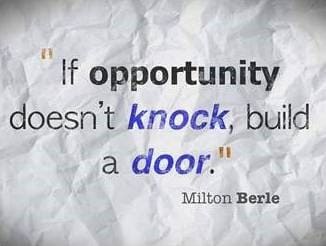
There is a quote often attributed to Milton Berle:
“If opportunity doesn’t knock, build a door.”
I’ve always liked the sentiment behind it.
Throughout my life and career, I’ve had the opportunity to meet people with very different personalities, backgrounds, priorities, and definitions of success. Some people are naturally driven. Others are more cautious or content to let life unfold.
There isn’t necessarily anything wrong with either personality.
But I have learned one thing: the things we truly want in life rarely happen without some degree of intentionality.
Hope Is Important. But Hope Isn’t a Plan.
We can hope for a better job.
We can hope to become financially secure.
We can hope to get healthier, start a business, travel, repair a relationship, buy a home, move somewhere new, or eventually retire comfortably.
Hope can give us a reason to begin. Faith can give us the courage to continue.
But eventually, there is usually something we have to do.
It reminds me a little of playing the lottery. Someone certainly wins, which makes the possibility exciting. But buying lottery tickets isn’t a particularly reliable financial strategy. For most of us, building financial stability happens through much less exciting things: earning, saving, planning, investing wisely, and making thousands of small decisions over time.
Many of our other goals work the same way.
Start With the Destination—Then Work Backward
One of the most useful questions we can ask ourselves is surprisingly simple:
What do I actually want?
Not what everyone else thinks I should want.
Not what looks impressive on social media.
Not even what I wanted ten years ago.
What matters to me now?
Once you can answer that, the next question becomes:
What would realistically need to happen for me to get there?
That turns a dream into something more tangible.
If you want to change careers, perhaps the first step is researching what qualifications employers are actually seeking.
If you want to improve your finances, perhaps it means looking honestly at the numbers and creating a savings goal.
If you want to start a business, maybe it begins with testing the idea before investing heavily in it.
And sometimes the goal is simply creating more freedom, peace, or flexibility in the next season of life.
You don’t necessarily need a five-year plan.
You need a next step.
Sometimes the “Door” Is Literally a Front Door
Real estate is one of the places where I see this principle play out regularly.
People will sometimes say:
“Someday I’d like to buy a house.”
Or:
“Eventually we’ll probably sell and downsize.”
“I’d love to own an investment property.”
“When the kids are gone, I want something smaller.”
Those are perfectly good dreams. But “someday” can quietly turn into five or ten years unless we begin asking practical questions.
For a buyer, intentionality might mean learning what you can comfortably afford, improving your credit, understanding financing options, researching communities, or simply finding out what homes in your preferred area actually cost.
Optional link: Planning to Buy a Home? Start With My Buyer’s Workbook →
For a homeowner considering a sale, it might mean understanding the property’s current condition, researching its market position, deciding which improvements are worthwhile—or recognizing that selling as-is may make more sense.
You don’t have to be ready to put a sign in the yard just because you’re gathering information.
Sometimes the first intentional step is simply understanding your options.
Optional link: Thinking About Selling? Explore Your Selling Options →
Plans Can Change
Intentionality doesn’t mean controlling every outcome.
I’ve made plenty of plans that changed.
Sometimes circumstances change. Sometimes new information changes our direction. Sometimes a door we were convinced should open stays firmly closed—and another opportunity appears that we hadn’t considered.
A good plan isn’t a prison.
It’s a direction.
It gives you somewhere to begin while leaving room to adjust along the way.
That is particularly important when making major decisions involving careers, finances, family, or real estate. Good information can help us make thoughtful decisions, but there will always be variables we cannot predict.
What Door Do You Need to Build?
Maybe there is something you’ve been saying you want to do for years.
Instead of asking whether you can accomplish the entire thing today, ask yourself something smaller:
What is one realistic step I could take toward it?
Make the phone call.
Research the opportunity.
Create the budget.
Schedule the appointment.
Ask the question.
Learn what you don’t know.
You don’t need to see the entire staircase before taking the first step.
Sometimes opportunity knocks.
Sometimes God opens a door we never could have opened ourselves.
And sometimes we are given the ability, wisdom, resources, and responsibility to start building one.
Dream. Pray. Plan. Then take the next step.
Leave a Reply