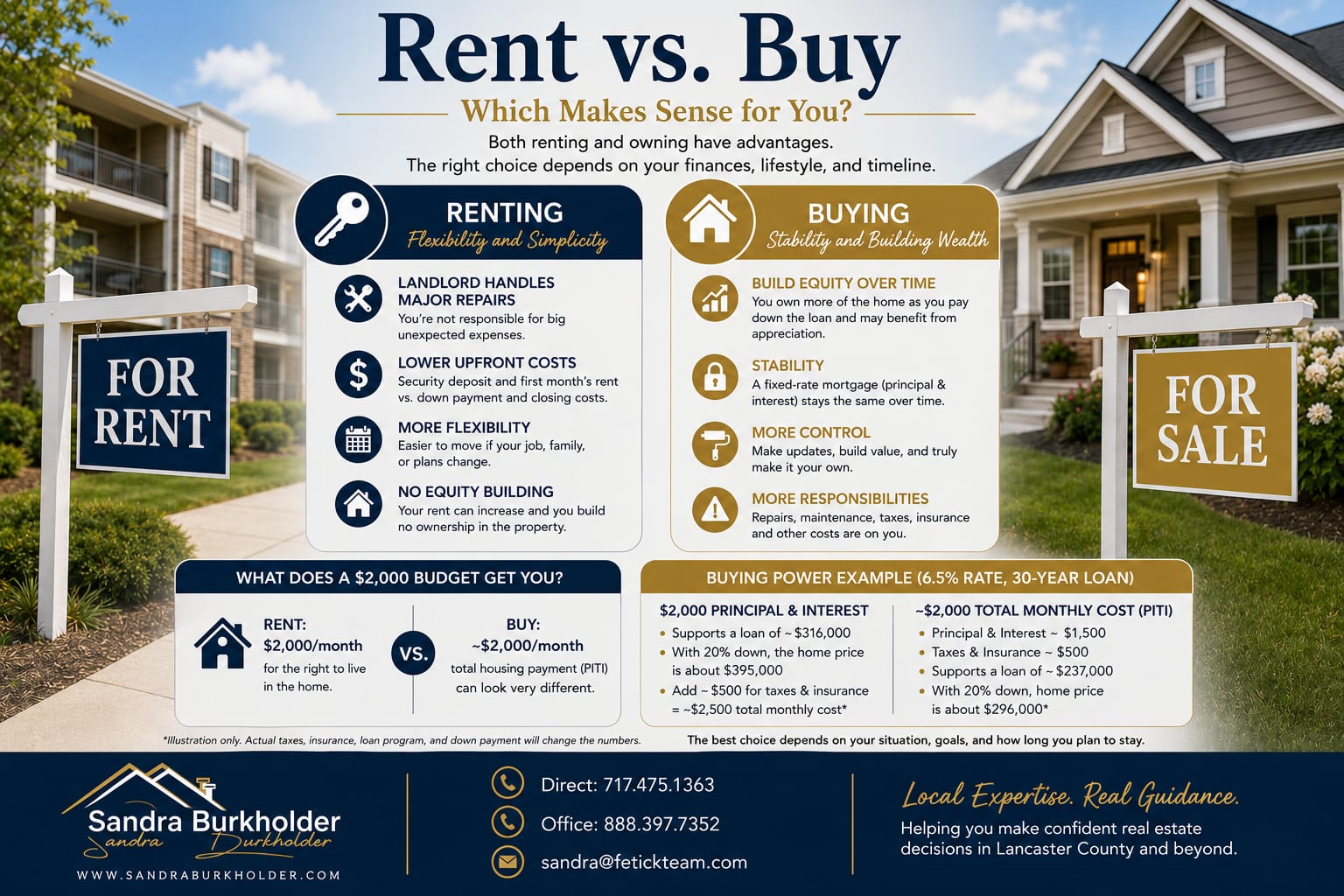
One of the most common questions in real estate is:
“If I’m paying $2,000 a month in rent, shouldn’t I just buy a house?”
Sometimes the answer is yes.
Sometimes it’s no.
Real estate agents spend plenty of time talking about the benefits of homeownership, and there are real benefits. But buying a home isn’t automatically a better financial decision than renting. The better choice depends on your finances, how long you expect to stay, how much flexibility you need, and what owning a comparable home would actually cost.
The important part is making an apples-to-apples comparison.
What Are You Paying for When You Rent?
When you rent, you’re paying for the right to live in a property without assuming most of the long-term financial responsibilities of owning it.
Your monthly rent generally covers your use of the home, while the property owner remains responsible for property taxes, building insurance and major repairs and maintenance.
If the furnace needs to be replaced or the roof starts leaking, those expenses generally belong to the landlord rather than the tenant.
The trade-off is that you don’t build equity in the property. Your rent can also increase, and you have less control over the property and how long it will remain available to you.
But that doesn’t make rent “wasted money.”
Rent pays for housing, flexibility and freedom from many of the financial risks associated with owning real estate.
What Are You Paying for When You Own?
A homeowner’s monthly housing expense has several pieces.
There is the mortgage principal and interest, but there may also be:
- Property taxes
- Homeowners insurance
- Private mortgage insurance (PMI), depending on the loan
- HOA fees, if applicable
- Maintenance and repairs
And then there are expenses that don’t arrive neatly every month.
A roof may last many years, but eventually it needs to be replaced. The same applies to HVAC equipment, appliances, plumbing, electrical systems, exterior maintenance and countless smaller repairs.
Homeowners should therefore have some room in their budget beyond simply making the mortgage payment.
So What Does a $2,000 Mortgage Payment Actually Buy?
This is where rent-versus-buy conversations can become confusing.
Someone might say:
“I’m paying $2,000 in rent. Why wouldn’t I put that $2,000 toward a mortgage?”
The problem is that $2,000 of rent isn’t necessarily comparable to $2,000 of mortgage principal and interest.
Using a hypothetical 6.5% interest rate on a 30-year mortgage, here’s roughly what the numbers look like.
A $2,000 monthly principal-and-interest payment would support a mortgage of approximately $316,000.
If you were putting 20% down, a $316,000 mortgage would translate into a home price of roughly:
$395,000
That sounds like $2,000 rent versus a nearly $400,000 house.
But that’s not the whole story.
The $395,000 House Doesn’t Really Cost $2,000 a Month
The approximately $2,000 payment in that example is only principal and interest.
The homeowner still has property taxes and homeowners insurance.
Lancaster County taxes vary considerably depending on the municipality and school district, so there isn’t one tax figure we can use for every property.
For illustration only, suppose taxes and homeowners insurance added another $500 per month.
Now the monthly housing cost is closer to:
$2,000 principal & interest
+ $500 estimated taxes & insurance
= $2,500 per month
And that still doesn’t include maintenance.
So comparing a $2,000 rental to a $395,000 home with a $2,000 mortgage payment isn’t really an equal comparison.
What If You Want Your TOTAL Housing Payment to Stay Around $2,000?
That’s a different question—and often the more useful one.
If you want your mortgage principal, interest, taxes and homeowners insurance combined to remain around $2,000 per month, you need to reserve part of that $2,000 for taxes and insurance.
For example, if we hypothetically allowed about $500 per month for taxes and insurance, we’d have about $1,500 available for principal and interest.
At a hypothetical 6.5% rate, $1,500 of principal and interest supports a loan of approximately $237,000.
With 20% down, that would correspond to a purchase price of roughly:
$296,000
So our comparison starts looking more like this:
| Renting | Buying Example | |
|---|---|---|
| Home price | — | ~$296,000 |
| Down payment (20%) | — | ~$59,000 |
| Mortgage | — | ~$237,000 |
| Principal & interest | — | ~$1,500/mo |
| Est. taxes & insurance* | — | ~$500/mo |
| Approx. housing payment | $2,000/mo | $2,000/mo |
*Illustration only. Actual Lancaster County property taxes and insurance vary by property and location.
That’s a much more meaningful comparison.
And if you’re purchasing with 5%, 10% or another down-payment amount, the numbers change again. Mortgage insurance may also enter the equation.
That’s why a lender should calculate the actual payment for a particular buyer rather than relying on a general online estimate.
But the Buyer Is Building Equity
This is the other side of the equation.
Not all of that mortgage payment disappears as an expense.
A portion goes toward paying down the principal balance of the loan. Over time, the homeowner owns more of the property.
If the property also appreciates, the homeowner may benefit from that increase in value.
That’s one of the primary financial advantages of owning real estate.
But building equity takes time.
Buying and selling also have transaction costs. If you buy a house and need to sell relatively soon afterward, appreciation and principal reduction may not be enough to offset those costs.
When Renting Can Be the Better Decision
Renting can make a great deal of sense if you’re unsure where you’ll be in a year or two.
It can also be appropriate if you’re moving into Lancaster County and aren’t sure which community fits you, if purchasing would consume most of your savings, or if your career, household or financial situation is likely to change.
Someone paying $2,000 to rent a property might also be renting a home that would cost considerably more than $300,000 to purchase.
In that situation, renting may provide access to a particular neighborhood or type of home for considerably less than the current cost of owning something comparable.
Flexibility has value. Here is a Rental Search: Click Here to find rentals.
When Buying Can Be the Better Decision
Buying becomes more compelling when you expect to remain in an area for several years, have sufficient savings beyond your down payment and closing costs, and can comfortably handle the complete cost of homeownership.
It can provide greater housing stability, more control over your home and an opportunity to build equity over time.
And unlike rent, a fixed-rate mortgage’s principal-and-interest payment doesn’t increase simply because the market changes, although taxes, insurance and other ownership expenses can increase.
For someone planning to stay for the longer term, those advantages can become significant. Click here to search for homes.
Don’t Forget the Opportunity Cost of the Down Payment
There’s one more piece people don’t always consider.
In our hypothetical $296,000 purchase with 20% down, the buyer puts approximately $59,000 into the property before considering closing costs.
That money becomes part of the buyer’s equity, but it is no longer sitting in a savings or investment account.
A renter might keep that money invested or available for other purposes.
Conversely, a homeowner may benefit from leverage—controlling a much larger asset with a relatively smaller initial investment.
Neither is automatically better. They’re different financial strategies.
The Question Isn’t Simply “Rent or Buy?”
I don’t particularly like the phrase:
“Renting is throwing money away.”
Homeowners also spend money that doesn’t become equity: mortgage interest, property taxes, insurance, maintenance and transaction costs.
Renters pay for housing and flexibility.
Homeowners pay for housing while also gaining the opportunity to build equity.
The better question is:
“Which option puts me in the stronger financial and lifestyle position over the next several years?”
For one person, that might mean buying a $300,000 home instead of continuing to pay $2,000 in rent.
For another, it might mean renting for another year, building savings, learning Lancaster County, improving their financial position or simply keeping their options open.
Good real estate advice shouldn’t begin with “You should buy.”
It should begin by understanding the numbers, your timeline and what you want your life to look like—and then deciding whether renting or owning actually supports those goals.
The mortgage examples above are for educational illustration only and aren’t a loan quote or representation of current financing available to a particular buyer. Interest rates, taxes, insurance, PMI, HOA fees, loan programs and individual qualifications can substantially change purchasing power. A licensed mortgage professional can provide figures based on your individual circumstances.
Sandra Burkholder | eXp Realty, LLC
Lancaster County Real Estate
Direct: 717-475-1363
Office: 888-397-7352
Leave a Reply