If you’re considering buying or selling a rental property in Lancaster County, one number you’re likely to hear is the cap rate.
Cap rate—short for capitalization rate—is simply a way of looking at how much income a property produces compared with its value.
Whether you’re considering a Lancaster City duplex, a small apartment building, a mixed-use property, or a rental elsewhere in Lancaster County, understanding cap rate can help you look beyond the asking price and evaluate the property as an investment.
The Basic Cap Rate Formula
The formula is:
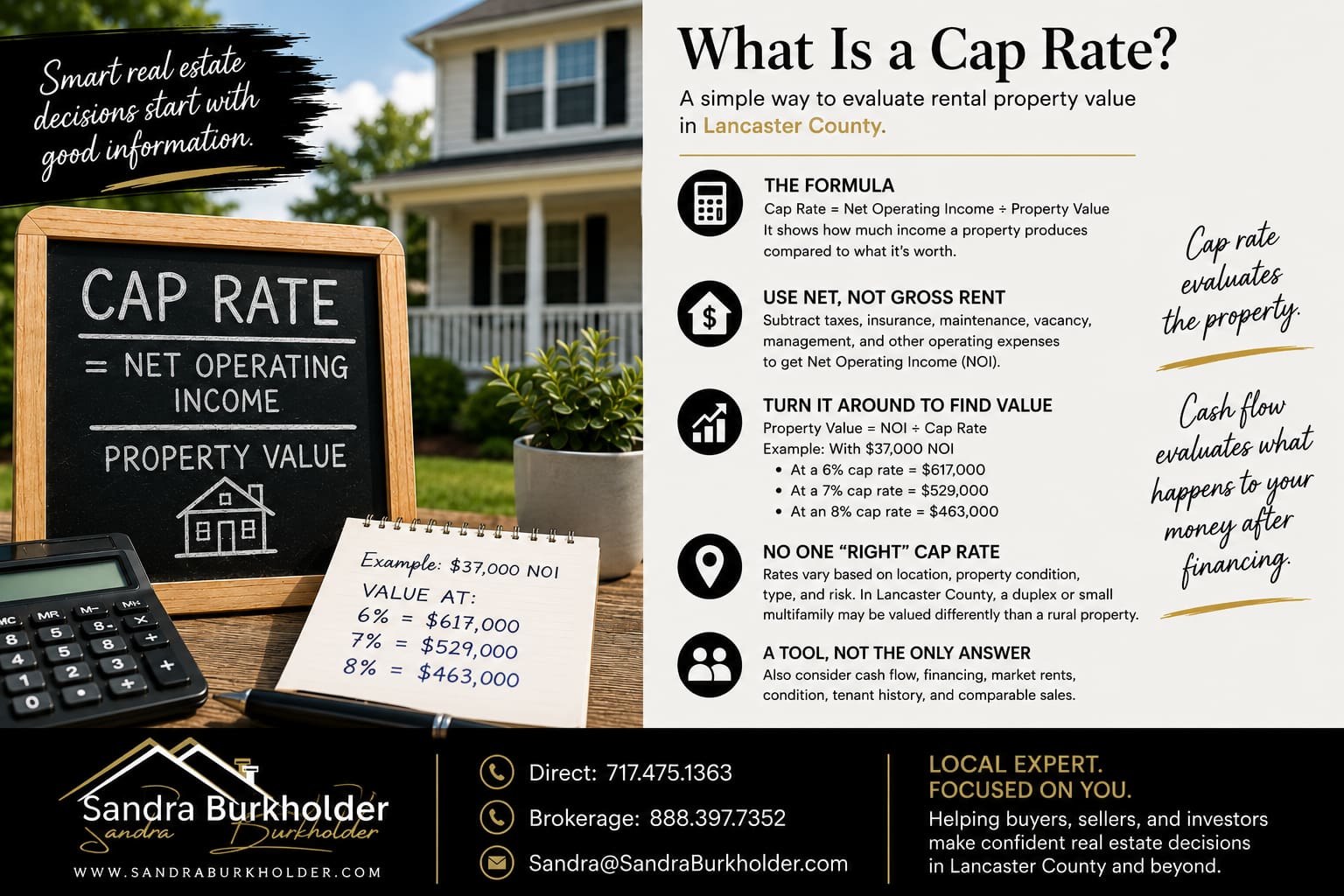
Cap Rate = Net Operating Income ÷ Property Value
Suppose a Lancaster County rental property has a Net Operating Income (NOI) of $40,000 per year and a value of $500,000.
$40,000 ÷ $500,000 = 8%
That’s an 8% cap rate.
In simple terms, the cap rate helps show how much income the real estate produces relative to what you’re paying for it—before considering the individual buyer’s financing.
Don’t Use Gross Rent
This is where people can get tripped up.
If a property collects $50,000 in annual rent, it doesn’t necessarily have $50,000 of income.
Before calculating the cap rate, we need to estimate the property’s Net Operating Income.
That means considering expenses such as:
- Property taxes
- Insurance
- Maintenance and repairs
- Property management
- Owner-paid utilities
- Vacancy allowance
- Other normal operating expenses
Mortgage payments generally aren’t included in NOI because we’re evaluating the performance of the property—not how a particular investor chooses to finance it.
Cap Rate Can Also Help Estimate Property Value
We can reverse the formula:
Property Value = NOI ÷ Cap Rate
For example, imagine a Lancaster County investment property producing $37,000 in annual NOI.
At a 6% cap rate, the indicated value would be approximately $617,000.
At a 7% cap rate, it would be approximately $529,000.
At an 8% cap rate, it would be approximately $463,000.
That’s a significant difference, which is why simply saying, “This is a 7% cap property,” isn’t enough. We also need to ask whether 7% is an appropriate cap rate for that particular property and location.
What Is a Good Cap Rate in Lancaster County?
There isn’t one Lancaster County cap rate.
A well-maintained property in a desirable location with strong rental history may trade differently from a property requiring substantial repairs or management.
Even within Lancaster County, investors may look differently at properties in Lancaster City, Lititz, Ephrata, New Holland, Columbia, Elizabethtown, or more rural areas.
Property type matters, too.
A duplex that could appeal to an owner-occupant may be evaluated differently from a six-unit apartment building purchased almost exclusively by investors. Mixed-use properties introduce another set of considerations because commercial and residential rents may need to be evaluated separately.
That’s why the appropriate cap rate should come from the market for comparable investment properties, rather than simply choosing a percentage that makes the numbers work.
Cap Rate Isn’t the Same as Cash Flow
This distinction is especially important for new investors.
A property can have an attractive cap rate and still produce disappointing cash flow after the mortgage payment.
Interest rate, down payment, loan terms and other financing costs determine how much money may actually remain in an investor’s pocket.
Cap rate evaluates the property.
Cash flow evaluates what happens to your money after financing.
Both matter.
Small Multifamily Properties Can Be Different
Lancaster County has plenty of duplexes, triplexes and other small residential investment properties.
With these properties, I wouldn’t rely exclusively on cap rate.
Comparable sales matter because another buyer may purchase the property, live in one unit and rent the other. That owner-occupant demand can affect market value differently than it would for a larger apartment building.
For a small multifamily property, I like to look at the investment from several directions:
What are comparable properties actually selling for?
What is the property’s true NOI?
What cap rate does the purchase price represent?
What will cash flow look like with today’s financing?
Are the current rents at, above or below market?
What repairs or capital improvements are likely over the next several years?
When those pieces are considered together, you get a much better picture than you would from cap rate alone.
The Simple Takeaway
If you remember only one thing, remember this:
Income tells us what the property produces. Cap rate helps us understand what investors may be willing to pay for that income.
For Lancaster County investors, cap rate is a valuable starting point—but property condition, location, rents, expenses, comparable sales and financing ultimately need to be considered together.
Whether you’re looking at your first duplex or evaluating a larger investment property, the goal isn’t simply to find the highest cap rate.
It’s to understand what you’re buying, what it actually earns, what risks you’re taking, and whether the numbers make sense for you.
Sandra Burkholder | eXp Realty, LLC
Lancaster County Real Estate | Residential, Investment & Relocation
Office: 888-397-7352
Leave a Reply