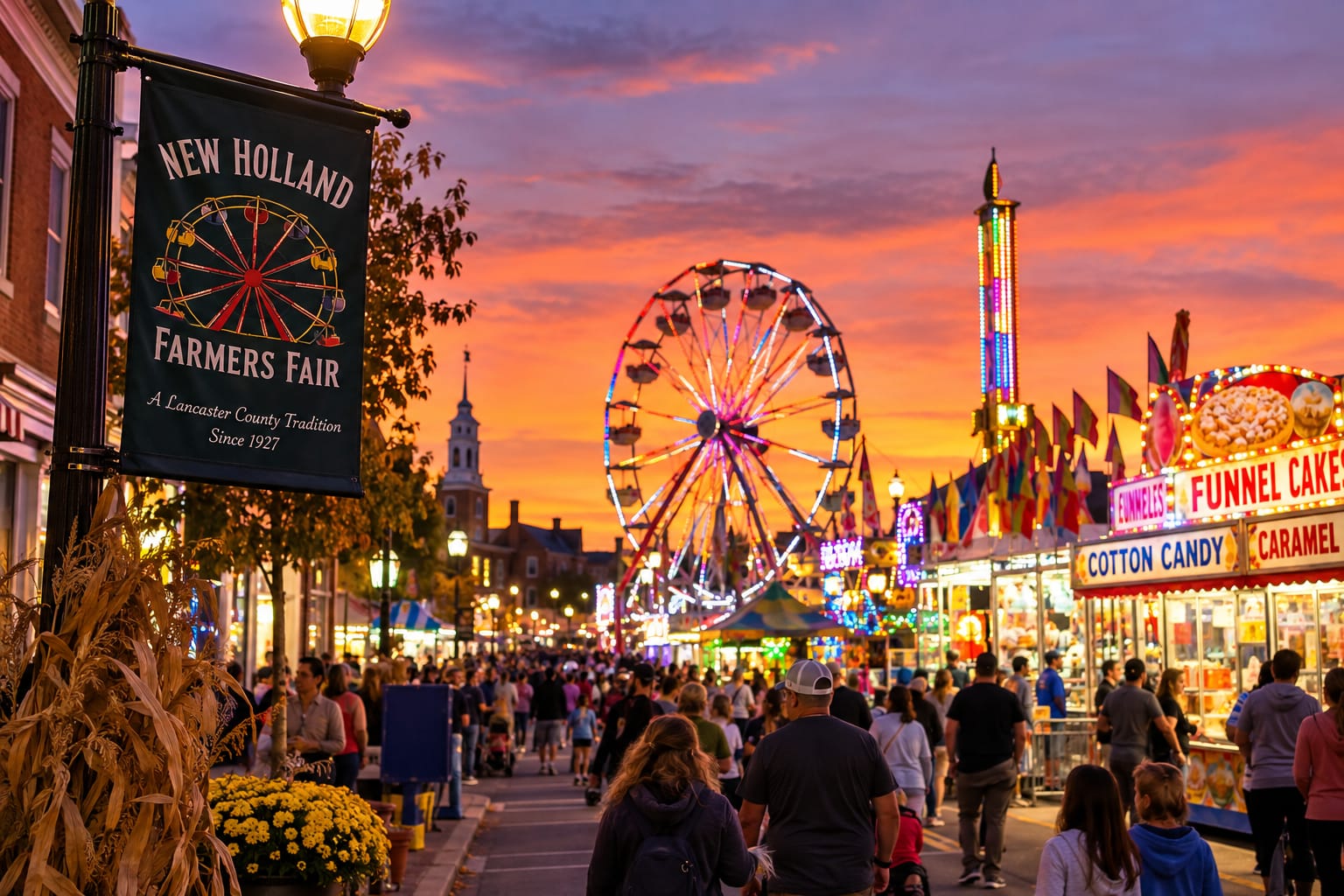
I’m going to the New Holland Farmers Fair this week, and it made me curious about something I’ve probably never given much thought to:
How did the New Holland Fair actually get started?
I’ve lived around Lancaster County long enough to know that fall fairs are simply part of life here. We know when they’re coming. Traffic changes. Main Streets close. Ferris wheels suddenly appear above buildings where Ferris wheels definitely aren’t there the rest of the year.
There are tractors and livestock, french fries and funnel cakes, teenagers walking around in groups, little kids begging for another ride, and people running into neighbors they haven’t seen in months.
But I realized I didn’t really know where the tradition came from.
So I started looking into the history of the New Holland Farmers Fair.
And, in typical Sandra fashion, I didn’t stop there.
If New Holland had a fair, what about Ephrata? And Denver? And Elizabethtown?
That sent me down a Lancaster County fair-history rabbit hole.
What I found was more interesting than I expected, because our fairs aren’t simply carnivals that happen to show up every fall.
Their histories tell quite a bit about Lancaster County itself.
New Holland Farmers Fair: A Community Experiment That Worked
The New Holland Farmers Fair began in 1927.
In August of that year, five local men — H. Earle Wright, E.L. Knecht, L.M. Storb Sr., Eli M. Hess and Harry E. Ressler — were selected to investigate the possibility of creating a Farmer’s Day Association in New Holland.
Interestingly, New Holland wasn’t inventing the idea from scratch.
Local businesspeople had been watching the success of Farmer’s Day exhibitions in places including Lititz, Manheim and Ephrata and began wondering whether New Holland could create something similar.
Apparently the answer was yes.
Very much yes.
The first Farmer’s Day Show was scheduled for October 21 and 22, 1927.
That gave organizers only a matter of weeks to pull it together.
Local businesses offered their storefront windows for exhibits. The high school auditorium housed displays of corn, potatoes, tobacco and vegetables. Flowers were exhibited at the New Holland House, while poultry, livestock and dogs were housed at the Stauffer Sales Company.
Parts of Roberts Avenue and Main Street were closed.
Automobiles, farm machinery and household equipment went on display.
There were ribbons and prize money, food stands and entertainment.
Then the crowds arrived.
Attendance at that very first New Holland event was estimated at 15,000 to 18,000 people.
Imagine organizing a new community event in a matter of weeks in 1927 and having thousands of people show up.
The organizers ended the first show with a balance of $217.29 and decided to do it again.
Then It Got Bigger
The timing for the second fair couldn’t have been better.
New Holland celebrated its 200th anniversary in 1928, and the fair expanded to three days.
More streets were used. More exhibit categories were added. More commercial display spaces were created.
Attendance reportedly nearly doubled.
The New Holland Farmer’s Day Association was formally incorporated in 1933, and the fair continued developing through the Depression years.
Some of today’s familiar traditions appeared surprisingly early.
A Baby Parade was held in 1934. Women participated in a corn-husking contest in 1935. The first Pet Parade came in 1939.
The fair paused from 1941 through 1945 during World War II and returned in 1946.
By 1949, it had expanded to four days.
The Spectacle of Bands Parade moved to Wednesday evening in 1952, and the first Kids’ Day was held in 1953.
Over subsequent decades came tractor competitions, Tug-of-War, horseshoe pitching, Pedal Power, livestock shows and sales, and eventually even the Long John Eating Contest.
In 2009 — more than 80 years after the idea began — the New Holland Farmers Fair finally purchased a permanent building of its own at Franklin Street and Roberts Avenue.
Yet in some ways, the fair still operates much as it did in 1927.
The town itself becomes the fairgrounds.
That may be one of my favorite things about it.
But New Holland Wasn’t First
This is where my little research project started expanding.
Remember how New Holland’s organizers were studying fairs in other towns?
One of those towns was Ephrata.
And the Ephrata Fair has an especially interesting beginning.
Ephrata Fair: A Welcome Home That Became a Tradition
The Ephrata Fair dates to 1919, making it older than New Holland’s fair.
But it didn’t begin simply because someone thought Ephrata needed carnival rides and funnel cakes.
Its origins were tied to something much more significant.
The first Ephrata Fair began as a homecoming celebration for local servicemen returning from World War I.
A farm harvest celebration was added the following year, and by 1922 the event had become known as the Ephrata Farmers Day Fair.
Agriculture became central to the celebration.
Farmers displayed livestock, crops and handiwork. Competitions allowed farmers and families to compare what they had grown or made, but fairs also served an educational purpose. They gave agricultural families opportunities to see new techniques, equipment and ideas.
Entertainment eventually grew around those agricultural roots.
Today the Ephrata Fair describes itself as Pennsylvania’s largest street fair, and its Main Street setting is one of the things that makes it distinctive.
Yet underneath the rides, food stands and entertainment is essentially the same idea that took hold more than a century ago:
Bring the community together and celebrate the agricultural life surrounding it.
That first fair was held in 1919.
In 2026, Ephrata celebrated its 107th fair.
That’s remarkable.
Elizabethtown: A Much Younger Fair
Then I looked west.
Compared with Ephrata and New Holland, the modern Elizabethtown Fair is practically a youngster.
The current fair dates to 1973.
Its beginnings grew from an Elizabethtown Jaycees community picnic that developed into a multi-day fair. Interestingly, there had been an earlier Elizabethtown Community Fair that ended in 1960.
The newer fair was initially held on the campus of Elizabethtown College.
It later moved to the community park, and in 1981 it relocated to acreage adjoining the Elizabethtown Area School District and Elizabethtown Brethren in Christ Church — the area where the fair continues today.
And while today’s Elizabethtown Fair certainly includes rides, entertainment and plenty of food, agriculture remains at its center.
Animals, agricultural exhibits and competitions give people who don’t live or work on farms an opportunity to encounter Lancaster County agriculture up close.
Local churches and civic organizations also use the fair as an important fundraiser, while businesses and community organizations participate throughout the week.
So although Elizabethtown’s fair is considerably younger, its purpose looks surprisingly similar to the fairs established decades earlier.
It’s about agriculture — but it’s also about community.
Denver: The New Kid in the Group
Then there’s Denver.
If Elizabethtown is young compared with New Holland and Ephrata, the Denver Fair is even younger.
Its story began in 1981, when volunteers led by the Denver Lions Club met to discuss creating a community fair.
The first Denver Community Fair was held that September.
It was modest compared with today’s event.
The first fair ran primarily Friday and Saturday, with a Thursday evening preview. It included a sheep show, arts and crafts, entertainment, contests, seven rides and 22 game and food stands.
And there was something called a turkey chase.
I have questions.
There was also a Friday night parade, followed by the Younger Brothers Band performing from a flatbed truck in Denver Memorial Park.
Unlike today’s fair, admission was originally charged.
By 1983, the Denver Fair had become free to attend.
The event continued growing, and in 1990 the fair committee separated from the Denver Lions Club and became an independent nonprofit organization.
Today the fair is a five-day event held in September and attracts more than 40,000 visitors, according to the Denver Fair organization.
It now includes more than 25 amusement rides and approximately 80 food and game concession stands, along with entertainment, contests and community activities.
But one detail about Denver’s history stood out to me.
Since 1982, the fair organization says it has invested more than $275,000 into Denver Memorial Park, along with providing an annual scholarship to a Cocalico High School senior.
So the fair doesn’t simply happen in the community.
It has helped support the community around it.
Four Fairs, Four Different Beginnings
Once I started comparing them, I realized these four fairs tell four slightly different stories.
Ephrata — 1919
Began as a welcome-home celebration for World War I servicemen and soon incorporated a farm harvest celebration.
New Holland — 1927
Local farmers and businesspeople deliberately created an agricultural community event after studying successful fairs in neighboring towns.
Elizabethtown — 1973
The modern fair grew from a Jaycees community picnic into a larger agricultural and community event.
Denver — 1981
Volunteers led by the Denver Lions Club created a new community fair that has since grown into a major annual event.
Different beginnings.
Different towns.
Different generations.
But a remarkably similar idea runs through all of them.
Lancaster County’s Fairs Were Never Just About Rides
That’s probably my biggest takeaway from researching all of this.
Today, we may think of a fair and immediately picture the midway.
The lights.
The Ferris wheel.
The food.
The games.
But that’s not really where Lancaster County’s fair tradition began.
These events were deeply connected to agriculture, local commerce and community life.
A century ago, a farmer displaying corn, tobacco, livestock or potatoes wasn’t participating in some quaint historical reenactment.
This was his livelihood.
Agriculture was business.
The fair gave farmers a place to compare livestock and crops, learn from one another, see equipment and technology, compete for prizes and connect with other people involved in the same work.
Local businesses participated because agriculture and local commerce were intertwined.
Families came because this was their community.
That connection is still visible today.
We may have added bigger rides, more entertainment and considerably more ways to deep-fry food, but livestock shows, agricultural exhibits, 4-H and FFA programs, tractor competitions, baking, sewing, crafts and local organizations are still there.
Why I Think These Traditions Still Matter
Lancaster County has changed tremendously since Ephrata held its first fair in 1919 or New Holland closed its streets in 1927.
We have new development, new industries and people moving here from all over the country.
Most Lancaster County residents no longer make their living directly from farming.
But agriculture is still an enormous part of the landscape and identity of this county.
Maybe that’s part of why these fairs continue to matter.
They create a place where the old Lancaster County and the new Lancaster County meet.
Someone whose family has farmed here for generations can walk the same midway as someone who moved here six months ago.
A child who has never been near a farm animal can stand a few feet from one being shown by a child who helped raise it.
Local businesses, churches, farmers, nonprofits, volunteers and families all occupy the same few blocks or fairgrounds.
For a few days, community becomes something you can actually see.
And Now I’m Going to the Fair
All of this started because I’m heading to the New Holland Farmers Fair this week and thought it would be interesting to know how it began.
Now I suspect I’ll look at it a little differently.
When I walk down Main Street and see rides and food stands packed between familiar New Holland buildings, I’ll know people were doing a version of the same thing nearly a century ago.
The first New Holland Farmer’s Day Show was held in 1927.
In 2027, the New Holland Farmers Fair reaches its 100-year milestone.
And here’s something I especially like about that history:
The original organizers weren’t trying to manufacture a tourist attraction.
They were building something for their own community.
Nearly a century later, we’re still showing up.
Sometimes traditions survive simply because generation after generation decides they’re still worth keeping.
I’ll see you at the fair.
Leave a Reply